
The audience is either everyone, a behaviour pattern, or a hand-picked list.
All Users
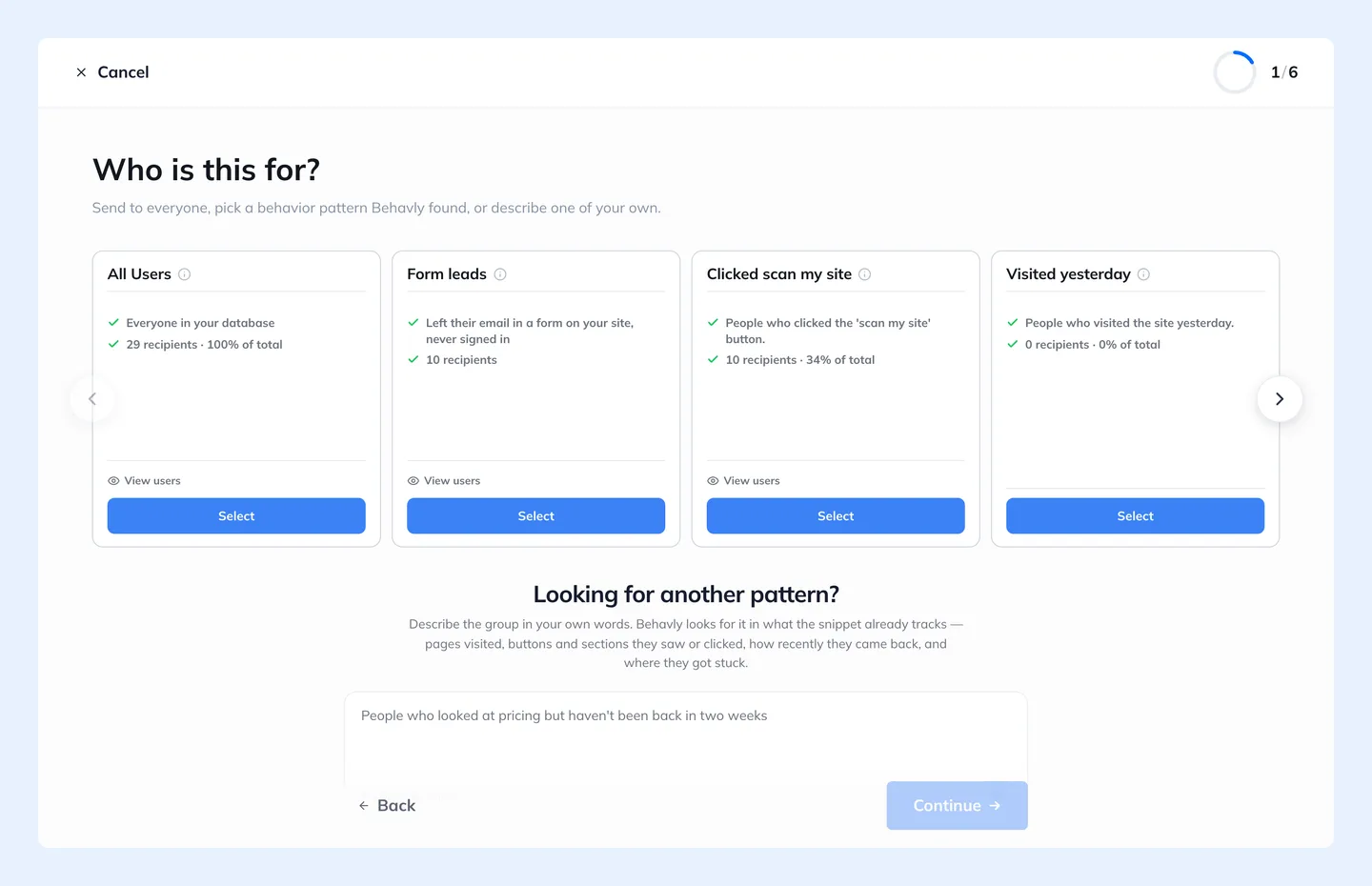
Everyone in your database for the selected site.
A Detected Pattern
Behavly reads your tracked behaviour and offers patterns it found — groups of people who did something in common. Each card carries an explainer that spells out the actual rule behind it, because a name like *Barely explored* is a label, not a definition.
Ask For A Pattern
Describe the group you want in plain language and Behavly turns it into a rule. The description is matched against a closed vocabulary of behavioural rules — it does not write a database query, and it cannot invent a rule Behavly does not support.
You are shown the resulting group and its size before anything is saved. That preview is the point: it is where you catch a description that was read differently than you meant it.
Form Leads
People who arrived through one of your forms rather than by signing in. They are a separate card, and they are excluded from All Users — a lead is not yet a user, and mixing the two makes both audiences wrong. Emails Behavly writes to them are built from their company's website rather than from behaviour. See Contacts vs Leads.
Specific People
Paste or pick email addresses directly.
Saved Patterns Re-Evaluate
A saved segment is stored as a rule, not as a list of members. Every time it is used it runs again against current data. A recurring campaign targeting *people who stalled in onboarding* reaches the people who are stalled this week, not the ones who were stalled when you created it.